



Contribute to Sustainability
Ensuring Equal Access: Women’s Application, Admission, and Graduation Outcomes
At TSUULL, our commitment to gender equality and equitable education is reflected in measurable outcomes. We systematically monitor key performance indicators (KPIs) across the student lifecycle, assessing not only women's access to higher education but also their academic progress, participation, and leadership.
The Registrar's Office at TSUULL serves as the central hub for tracking and analyzing student data, with a dedicated focus on fostering an inclusive and diverse academic community. Our office systematically monitors the entire student lifecycle, from the initial application stage through to graduation.
We meticulously track application and enrollment figures, always measuring the proportion between male and female students. This ongoing analysis allows us to identify trends, assess the effectiveness of outreach initiatives, and ensure our admissions processes uphold the university's commitment to equitable access.
Furthermore, our responsibility extends to monitoring graduation rates and academic degree attainment by gender. By comparing these outcomes with enrollment data, we can gauge not just who enters our university, but who succeeds and thrives. This data is crucial for measuring the real-world impact of our inclusive environment and for identifying any areas where additional support may be needed.
Related article
Key indicators
Total number of students
Bachelor’s by year of study
The university has 6,267 students: 5,736 in bachelor’s programmes (91.5%) and 531 in master’s (8.5%). Women are 94.5% of all students, 94.7% at bachelor’s level and 92.5% at master’s. There are 5,921 women and 346 men.
Base: all 6,267 enrolled students (5,736 bachelor’s + 531 master’s). These are the reference totals for the whole report.
| Level | Men | %men | Women | %women | Total/share of all |
| Bachelor's | 306 | 5.3% | 5,430 | 94.7% | 5,736 / 91.5% |
| Master's | 40 | 7.5% | 491 | 92.5% | 531 / 8.5% |
| TOTAL | 346 | 5.5% | 5,921 | 94.5% | 6,267 / 100.0% |
Students Distribution by region
Enrolment is concentrated in all regions. Kashkadarya (about 1,300, 20.7%), Tashkent Region (about 870, 13.9%) and Samarkand (about 571, 9.1%) together account for roughly 44% of students. Tashkent city adds about 7.6%, and the other regions are each below 7.2%. Values are estimates scaled to the exact total, except Namangan (338), which is exact.
| No. | Region | ≈ Students | Share |
| 1 | Kashkadarya Region | 1,300 | 20.7% |
| 2 | Tashkent Region | 870 | 13.9% |
| 3 | Samarkand Region | 571 | 9.1% |
| 4 | Tashkent city | 475 | 7.6% |
| 5 | Surkhandarya Region | 448 | 7.1% |
| 6 | Jizzakh Region | 404 | 6.4% |
| 7 | Namangan Region | 338 | 5.4% |
| 8 | Fergana Region | 326 | 5.2% |
| 9 | Bukhara Region | 316 | 5.0% |
| 10 | Andijan Region | 307 | 4.9% |
| 11 | Khorezm Region | 290 | 4.6% |
| 12 | Navoi Region | 246 | 3.9% |
| 13 | Syrdarya Region | 220 | 3.5% |
| 14 | Republic of Karakalpakstan | 141 | 2.2% |
| 15 | Other / not specified | 15 | 0.2% |
| TOTAL | 3,267 | 100.0% |
Sorted in descending order. Regional values are estimated from the dashboard chart (≈) and scaled so they add up to the exact total of 6,267 students; shares are calculated from that total. Namangan Region is exact: 311 bachelor’s + 27 master’s students.
By place of residence
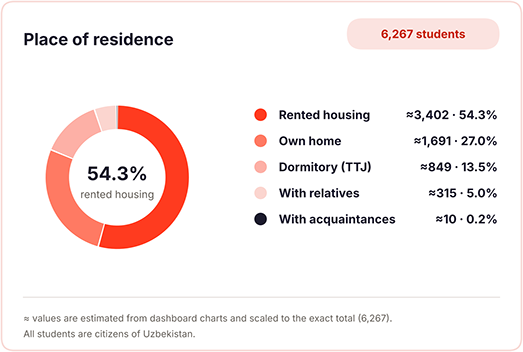
Rented housing is the most common (3,402, 54.3%), then own home (27.0%), dormitory (13.5%) and living with relatives (5.0%). Master’s students rent far more often (77.4%) and rarely use dormitories (0.9%), while 14.7% of bachelor’s students live in them. All students are citizens of Uzbekistan.
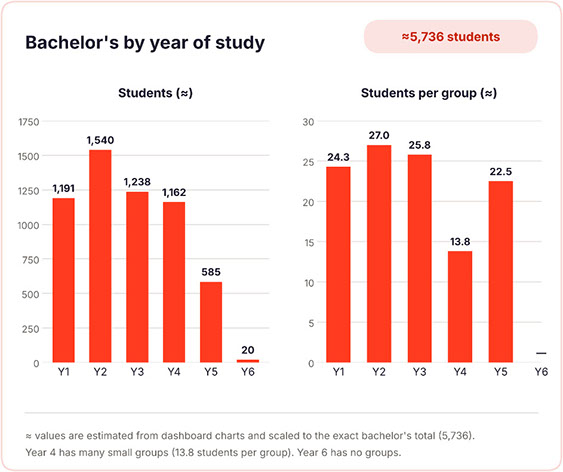
Year 2 is the largest cohort (about 1,540, 26.9%) and Years 1, 3 and 4 are each around 1,160–1,240. Year 5 has about 585 students and Year 6 only 20. Year 4 has 84 groups averaging about 13.8 students, against 22–27 in other years. Year 6 has no groups.
Base: 5,736 bachelor’s students (≈ by year of study).
| Year | ≈ Students | Share | ≈ Groups | Share | Students per group |
| Year 1 | 1,191 | 20.8% | 49 | 18.6% | 24.3 |
| Year 2 | 1,540 | 26.8% | 57 | 21.6% | 27.0 |
| Year 3 | 1,238 | 21.6% | 48 | 18.2% | 25.8 |
| Year 4 | 1,162 | 20.3% | 84 | 31.8% | 13.8 |
| Year 5 | 585 | 10.2% | 26 | 9.8% | 22.5 |
| Year 6 | 20 | 0.3% | 0 | 0.0% | — |
| TOTAL | 5,736 | 100.0% | 264 | 100.0% | 21.7 |
Students by year are estimated from the dashboard chart (≈) and scaled to the exact bachelor’s total of 5,736; group counts are as read from the chart. Overall students per group = bachelor’s students in years 1–5 ÷ 264 groups; the 20 Year 6 students have no groups.
Bachelor’s by study form
Full-time is the main form (about 4,006, 69.8%), followed by evening (14.2%), distance (8.7%) and part-time (7.3%). Women are the large majority in every form. Evening has the highest share of men (about 10%) and distance the lowest (3.6%).
Base: 5,736 bachelor’s students (306 men + 5,430 women), by study form (≈).
Counts by study form are estimated from the dashboard chart (≈) and scaled to the exact bachelor’s totals (306 men, 5,430 women). Special part-time, joint programmes, second degree and dual education: 0.
| Form | Men | %men | Women | %women | Total | Share |
| Full-time | 174 | 4.3% | 3,832 | 95.7% | 4,006 | 69.8% |
| Evening | 84 | 10.3% | 728 | 89.7% | 812 | 14.2% |
| Distance | 18 | 3.6% | 479 | 96.4% | 497 | 8.7% |
| Part-time (extramural) | 30 | 7.1% | 391 | 92.9% | 421 | 723 |
| TOTAL | 306 | 5.3% | 5,430 | 94.7% | 5,736 | 100.0% |
First-generation students
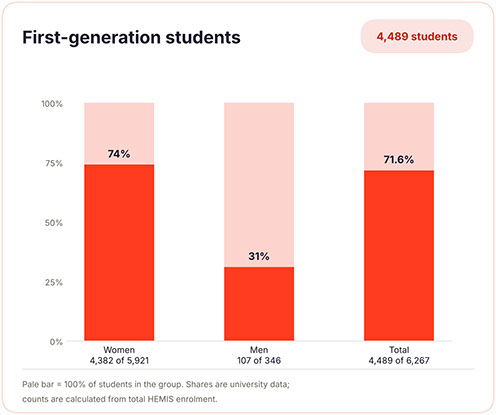
About 4,489 students (71.6%) are first-generation. The share is 74% for women (4,382) and 31% for men (107), so first-generation status is far more common among women.
Gender equity at TSUULL
Admissions for gender equity
Tashkent State University of Uzbek Language and Literature (TSUULL) has clear and accessible admission pathways into higher education. They reflect the University’s commitment to gender equality and to helping women from every background succeed in their studies and careers. Our Regulation on the Procedure for Granting Recommendations to Women from Low-Income Families and Regulation on Reimbursing the Tuition Fees of Female Students in Master’s Programs support this commitment. Both were adopted in March 2016 and are reviewed annually. Through them, TSUULL gives girls and women access to higher education and takes planned action to help them apply to the University, be accepted and take full part in university life.
The recommendation pathway plays a key role in widening access for women from low-income and socially vulnerable families. It was approved by Resolution of the Cabinet of Ministers No. 402 of 23 June 2020 and most recently updated in July 2025. It gives every eligible applicant the right to compete for her first-choice field of study under an additional 4% state grant quota, on top of the standard state-grant places.
The pathway is open to:
• women from families whose average monthly income per family member does not exceed 0.527 times the minimum monthly wage
• girls who have lost one or both parents
• widowed women raising minor children alone
• women from low-income families with a child with a disability
• girls whose mother is raising two or more children independently
• girls with a parent who has a first- or second-group disability
Applicants apply online through their District (City) Department of Family and Women’s Affairs between 30 May and 8 June. They receive their recommendation letters by 15 June, and each letter is valid for one year.
Within the University, the Registrar Office helps applicants prepare their applications and documents. It verifies applicant data together with the Admissions Committee and publishes the additional quota on the University website and information boards. The Working Group on Student Social Support oversees the process. Each year the Registrar Office reports to the Rector’s Office and the Committee on Family and Women’s Affairs on how many recommendations were received, verified and admitted.
This commitment continues into postgraduate study. Since the 2022/2023 academic year, the state budget has reimbursed the full tuition fee for one academic year for women studying in master’s programmes on a contract basis. This is set out in Resolution of the Cabinet of Ministers No. 447 of 15 August 2022, as amended by Resolution No. 135 of 1 March 2025. Women apply to the rector by 15 September, and the rector confirms the reimbursement by order no later than 15 October. This removes a key financial barrier to completing advanced study. The University publishes information on the funds received on its website, updated quarterly, and the State Financial Control Inspectorate oversees how the funds are used.
The results of these pathways show in our student community:
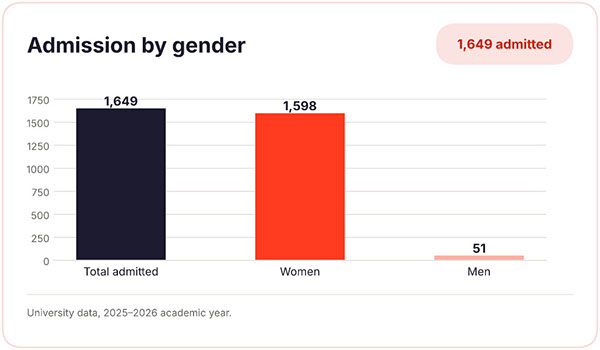
Admissions: women made up 96.9% of new students in 2025–2026 (1,598 of 1,649).
Enrolment: women are 94.5% of all 6,267 enrolled students.
First-generation students: 74% of our women students are the first in their family to attend university.
Supporting women to graduate
At TSUULL, our commitment to gender equality continues beyond admission. We support women to complete their studies and graduate. The University records graduation by gender and level of study, which lets us see how women progress through bachelor’s and master’s programmes.
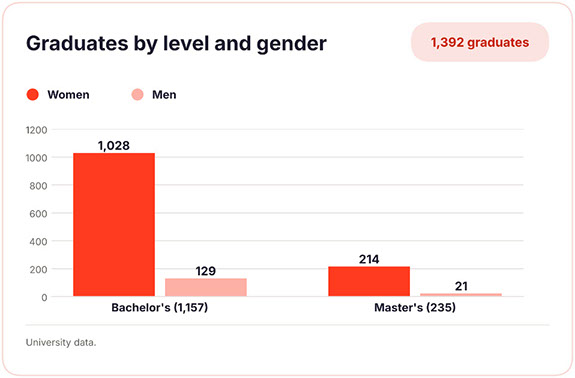
In 2025, 1,392 students graduated from TSUULL, and 1,242 of them (89.2%) were women.
| Level | Women | Men | Total | Women's share |
| Bachelor’s | 1,028 | 129 | 1,157 | 88.8% |
| Master’s | 214 | 21 | 235 | 91.1% |
| Total | 1,242 | 150 | 1,392 | 89.2% |
Bachelor’s graduates made up 83.1% of all graduates, and master’s graduates 16.9%.
Women make up a large majority of our students at every stage of study:
| Stage | Women's share |
| New admissions, 2025–2026 | 96.9% |
| All enrolled students | 94.5% |
| Graduates, 2025 | 89.2% |
These figures come from different cohorts. They show women’s share at each stage, but they do not follow the same students from admission to graduation.
The support women receive at entry helps them stay in their studies and finish them. The additional 4% state grant quota for women from low-income families gives them a funded place from their first year. The Working Group on Student Social Support oversees the social support process for these students. At postgraduate level, full state reimbursement of one year’s tuition for women studying on a contract basis removes a key financial barrier to completing advanced study.
Many of our women students are the first in their family to attend university. For them, these measures help turn access to higher education into a degree. Each graduate shows the University’s commitment to helping women from every background succeed in their studies and careers.
Women’s admission rate
In 2025–2026 the University admitted 1,598 women among 1,649 first-year students, so women made up 96.9% of the intake. This is the highest share of women at any stage reported, above their share of all enrolled students (94.5%) and of graduates (89.2%). Many of these women come from families with no history of higher education: 74% of women students at the University are first-generation (Section 7).
Women make up 5,921 of the University’s 6,267 students (94.5%). There are 5,430 women at bachelor’s level (94.7% of bachelor’s students) and 491 at master’s level (92.5% of master’s students). Women are the large majority in every form of bachelor’s study:
Full-time: 3,832 women (95.7%)
Evening: 728 women (89.7%)
Distance: 479 women (96.4%)
Part-time (extramural): 391 women (92.9%)
Their share is highest in distance and full-time study and lowest in evening study. Of all women students, 4,382 (74%) are the first in their family to attend university, compared with 31% of men.
Women’s enrollment rate
Women’s enrollment rate
In 2025, 1,242 women graduated from the University, 89.2% of all 1,392 graduates. Of these, 1,028 completed bachelor’s degrees (88.8% of bachelor’s graduates) and 214 completed master’s degrees (91.1% of master’s graduates). Women’s share among graduates is lower than among first-year admissions (96.9%) and enrolled students (94.5%). These figures come from different cohorts, so they show how women’s share differs between stages, not how the same women progressed from admission to graduation.


Get involved
There are plenty of opportunities for our Flinders community to be involved in sustainability on campus

Latest News



Information

Address: 103, Yusuf Xos Khojib Street, Yakkasaray District, Tashkent

Contact: (+998 71) 2814511


Bus: 11, 32, 47, 76, 77, 81, 98, 126, 140
Programs
Talented girls
Women engagement
Qizlar gapirsin
Zakovat
Equality
We have
Research
Facilities
Statistics
Scholarships
Collaboration


Subway: “Xalqlar do‘stligi” station, “Oybek” station