



Key indicators
Contribute to Sustainability
Policy on Protection of Individuals Reporting Harassment and Discrimination
TSUULL is committed to ensuring a safe, inclusive, and respectful learning and working environment for all members of its community. This Regulation is based on the Laws “On Guarantees of Equal Rights and Opportunities for Women and Men” (No. O‘RQ-562) and “On Protection of Women and Girls from Harassment and Violence” (No. O‘RQ-561) of 2 September 2019, the Labour Code, the Law “On Education”, and other legislation of the Republic of Uzbekistan.
The main aims of this policy are to ensure the safety and well-being of all members of the TSUULL community. It seeks to prevent harassment, discrimination, coercion, and violence, with particular attention to gender-based cases, while establishing clear procedures for reporting, investigation, and protection. The policy guarantees confidentiality and protection against retaliation for those who report incidents and promotes a culture of respect, inclusion, and equality within the university environment. Additionally, it provides practical support and guidance to victims, including academic, psychological, and legal assistance, and fosters accountability among all community members to reinforce ethical conduct.
Related article
Regulation on the Protection of Individuals Reporting Harassment and Discrimination
| Policy Title | REGULATION on the Protection of Individuals Reporting Harassment and Discrimination |
| Issue Date | March 2016 |
| Review Date | March 2026 |
| Policy No. | REGULATION – March 2026 REGULATION on the Protection of Individuals Reporting Harassment and Discrimination at TSUULL |
| Approved By | Rector, TSUULL |
| Applicable To | This Regulation applies to students, applicants, academic and administrative staff, doctoral researchers, contractors, volunteers, visiting lecturers and visitors |
| Policy Lead | Registrar Office, Committee on Family and Women's Affairs, Human Resources Department |
Key Definitions
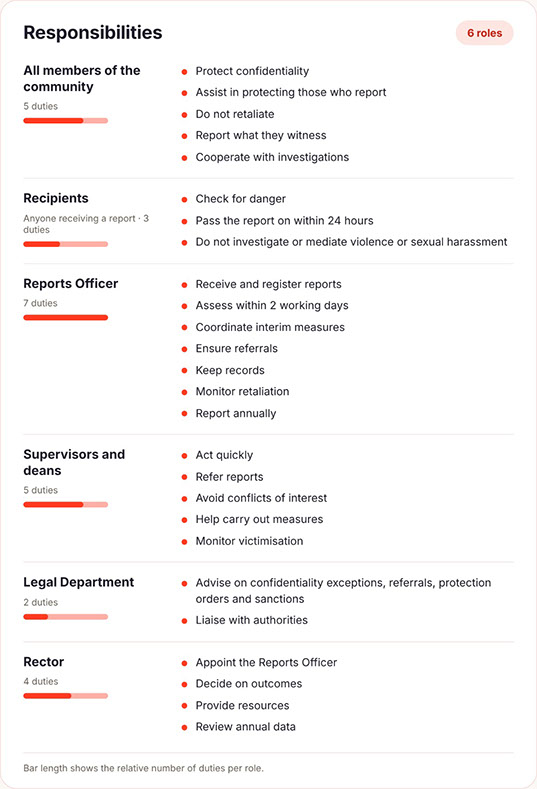
TSUULL and its governing bodies are committed to protecting every member of the university community. They do this by implementing the following responsibilities:
1.1. Harassment: conduct that demeans a person's honour and dignity, including shilqimlik and stalking, and that is not an administrative or criminal offence. It may be a single incident or a series.
1.2. Sexual harassment: unwelcome sexual advances, requests for sexual favours, or other unwelcome conduct of a sexual nature, in person, in writing or online, including comments on appearance, repeated invitations, sexual jokes, unwanted messages or images, and displaying sexual material. Silence or lack of objection is not consent.
1.3. Stalking: repeated contact, following or approaching a person, in person or online, after two or more refusals or warnings, causing fear for safety.
1.4. Discrimination: direct or indirect unequal treatment as defined in Law 562.
1.5. Bullying and psychological violence: repeated unreasonable behaviour that intimidates, humiliates or isolates a person, including excluding, spreading rumours, or denying information or resources.
1.6. Retaliation (detrimental treatment): any adverse action or threat because someone reported, helped, or gave evidence. Examples: lower grades, loss of scholarship or dormitory place, dismissal, demotion, transfer, exclusion from activities, harassment, damage to reputation, disciplinary action without cause.
1.7. Report: an oral or written communication of harassment, discrimination, coercion or violence. Complainant: the person making a report. Affected person: the person subjected to the conduct. Respondent: the person the report is about.
1.8. Good faith: a genuine belief that the information is true, whether or not it is later proven.
Investigation
9.1. The investigation is conducted by staff who are independent of the matter and trained for it, or by an external expert.
9.2. Steps: (a) record the complaint and particularize the allegations in writing; (b) inform the respondent of the allegations (with identity protections where needed); (c) give the respondent a fair opportunity to respond; (d) collect witness statements and evidence; (e) reach a finding on the balance of probabilities; (f) submit a recommendation to the decision-maker.
9.3. The investigation focuses on the substance of the report, not on the reporter's motive.
9.4. Timelines: 15 working days (extendable once by 10 with written reasons).
9.5. Where the facts indicate a possible crime, the university refers the matter under Section 12 and does not carry out a parallel fact-finding that could prejudice criminal proceedings; it continues with safety measures.
9.6. No person may secretly record meetings or conversations related to the complaint. Recording requires the consent of all participants.
Protection from retaliation
14.1. Retaliation against anyone who reports, supports a report, or gives evidence is prohibited and is treated as seriously as the original conduct.
14.2. Every member of the university community must help protect those who report.
14.3. Reports of retaliation may be made through the same channels (Section 4) and are handled as a priority. The Reports Officer reviews the situation of the complainant at 1, 3 and 6 months after the report.
14.4. Participation in the process may not be used as grounds for expulsion, dismissal, lower grades, or loss of scholarship, accommodation or position.
External routes and contacts
15.1. A person may report to the following at any time, in addition to or instead of the university: the internal affairs bodies (police); the prosecutor's office; the Family and Women's Committee and its free 24/7 confidential hotline (Law 561 § 18); the Commissioner for Human Rights (Ombudsman); the labour inspectorate; the Federation of Trade Unions; and the court. No state fee applies to discrimination complaints (Law 562 § 28) or to damages claims by victims of harassment and violence (Law 561 § 4).
15.2. The Regulation, the form and these contacts are published on the website, noticeboards, dormitories and induction material. (The Committee should verify names and numbers before publication, and add the national online complaints portal once it is operational.)
Approval and Implementation
Initially Approved: 04.08.2021
Reviewed, Amended, and Effective: 12.10.2024
Approved by: Vice-Rector for Youth Affairs and Spiritual Enlightenment
Rights of persons who report
Any person who reports has the right to:
1. have the report acknowledged within one working day;
2. be treated respectfully, with sensitivity and without blame;
3. have the matter handled discreetly and impartially;
4. receive information on the procedure, available support, and external options;
5. seek support at any time, and bring a support person to meetings (Section 11);
6. request protective and interim measures at any stage;
7. report without fear of retaliation;
8. be told the outcome (findings and measures affecting them) and the reasons if no investigation is carried out;
9. go to the police, the prosecutor, other public bodies or the court at any time (Section 15).
Who can report and how
4.1. Reports may be made by the affected person, a witness, a colleague, a parent or representative, or an organization.
4.2. Reports may be made (a) on the Reporting Form (Appendix 1), (b) by email, messenger or telephone to the Reports Officer, (c) in person to the Reports Officer or Safe Campus Focal Point, or (d) through a dean, teacher, HR or dormitory manager, who must pass it on within 24 hours.
4.3. Anonymous reports are accepted. The university will act on them as far as the information allows, but it may be unable to investigate fully or to give feedback.
4.4. A report should say what happened, when and where, who was involved, and what evidence exists. Lack of evidence is not a reason to refuse a report.
Decision, outcomes, updates and review
10.1. The decision-maker (Rector or authorized deputy) decides within five working days of the recommendation.
10.2. Possible outcomes: no action (not substantiated); informal action (coaching, restatement of expected behaviour); training; written warning or reprimand; changes of duties or study arrangements; loss of benefits; suspension; dismissal or expulsion; referral to police or court.
10.3. Factors: seriousness and frequency, evidence, prior incidents, position of authority, the affected person's views, and whether the respondent knew the conduct was prohibited.
10.4. Both parties receive a written decision with reasons and with the right to request a review within 10 working days by a person not previously involved.
10.5. The complainant is updated during the process and told the outcome of the part that concerns them, subject to privacy law. If it is decided not to investigate, the reasons are given in writing.
Protection from educational and employment disadvantage
14A.1. Policy statement. TSUULL protects every person who reports discrimination, harassment, coercion or violence in good faith from educational and employment disadvantage. This protection applies to students, applicants, academic and administrative staff, doctoral researchers, contractors and volunteers, and also to witnesses, persons who support a report, and persons who report to an external body.
14A.2. Educational disadvantage covers, among other things: lower or withheld grades, unfair assessment, refusal of retakes or extensions, loss or reduction of a scholarship or grant, loss of a dormitory place, change or withdrawal of supervision, exclusion from classes, projects, internships, exchange programmes or events, refusal of references or recommendations, refusal of transfer, readmission or graduation, suspension, expulsion, and unjustified disciplinary action.
14A.3. Employment disadvantage covers, among other things: dismissal, non-renewal or early termination of a contract, demotion, loss of duties, unfavourable transfer, reduction of pay, bonuses or workload allowances, refusal of promotion, training, leave or research funding, exclusion from committees or projects, unfavourable evaluation or attestation, unjustified disciplinary action, and threats of any of these.
14A.4. Protected even if not substantiated. Protection applies whether or not the report is proven, provided it was made in good faith (Section 6).
14A.5. Independent review of adverse decisions. For 12 months after a report, any decision that adversely affects the complainant (grade, assessment, contract, promotion, disciplinary or scholarship decision) must be documented with its reasons and checked by a person who was not involved in the report. The Reports Officer may suspend such a decision pending the check.
14A.6. Remedies. If disadvantage is found, the university must reverse the decision, restore the lost rights or benefits (grade re-assessment by another examiner, reinstatement, restored scholarship or accommodation), provide academic or professional support, and may take disciplinary action against the person responsible.
The person keeps the right to claim damages through the court (no state fee).
14A.7. Academic continuity. Absence or reduced performance caused by the incident, the investigation, a protective measure, or stay in a specialized centre is not a ground for expulsion, dismissal or loss of status. Make-up classes, extensions and flexible schedules are provided (see Law 561 § 28).
14A.8. Complaints about disadvantage. A person who believes they have suffered disadvantage may report it to the Reports Officer, the Rector, or an external body (Section 15). Reports of retaliation are handled as a priority within 2 working days.
14A.9. Sanctions. Retaliation is a serious disciplinary offence for staff and students and may lead to dismissal or expulsion. It is also reported to law enforcement where it amounts to an offence.
Let’s stop discrimination together


Get involved
There are plenty of opportunities for our Flinders community to be involved in sustainability on campus

Latest News



Information

Address: 103, Yusuf Xos Khojib Street, Yakkasaray District, Tashkent

Contact: (+998 71) 2814511


Bus: 11, 32, 47, 76, 77, 81, 98, 126, 140
Programs
Talented girls
Women engagement
Qizlar gapirsin
Zakovat
Equality
We have
Research
Facilities
Statistics
Scholarships
Collaboration


Subway: “Xalqlar do‘stligi” station, “Oybek” station